
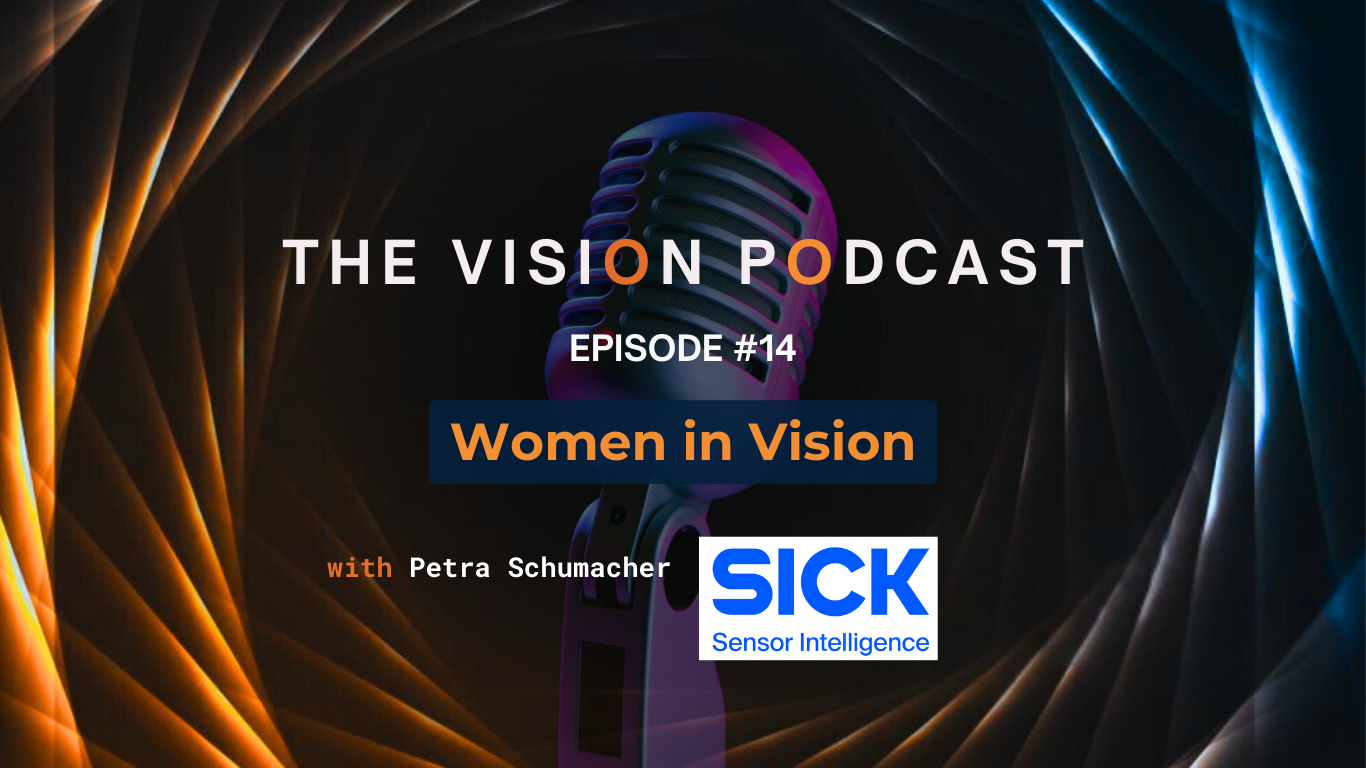
MVPro Media – The Vision Podcast #14
Guest – Petra Schumacher, SICK AG
Episode Sponsor – AIRON
Petra joins Josh and talks about her early career in machine vision and her passion for empowering other women to explore engineering. They discuss key influences and experiences that helped her turn an interest into a exciting, multi-disciplinary career.
“Technology is all about experimenting, failing, getting back up — and encouraging girls to take more risks.” — Petra Schumacher
On this page:
- Podcast player
- Episode sponsor
- Guest information
- Episode chapters
- Episode transcript
Listen to the Episode
Episode Sponsor
Tired of overpaying for machine vision components? Meet Airon. They deliver high-end laser triangulation sensors, precision lenses, lighting solutions, industrial computers, and more at a smarter price. As systems integrators with 15 years of experience, they sell only what they trust in their own projects. Stop paying more. Shop at aoi-airon.com. Shipped globally today.
About our Guest
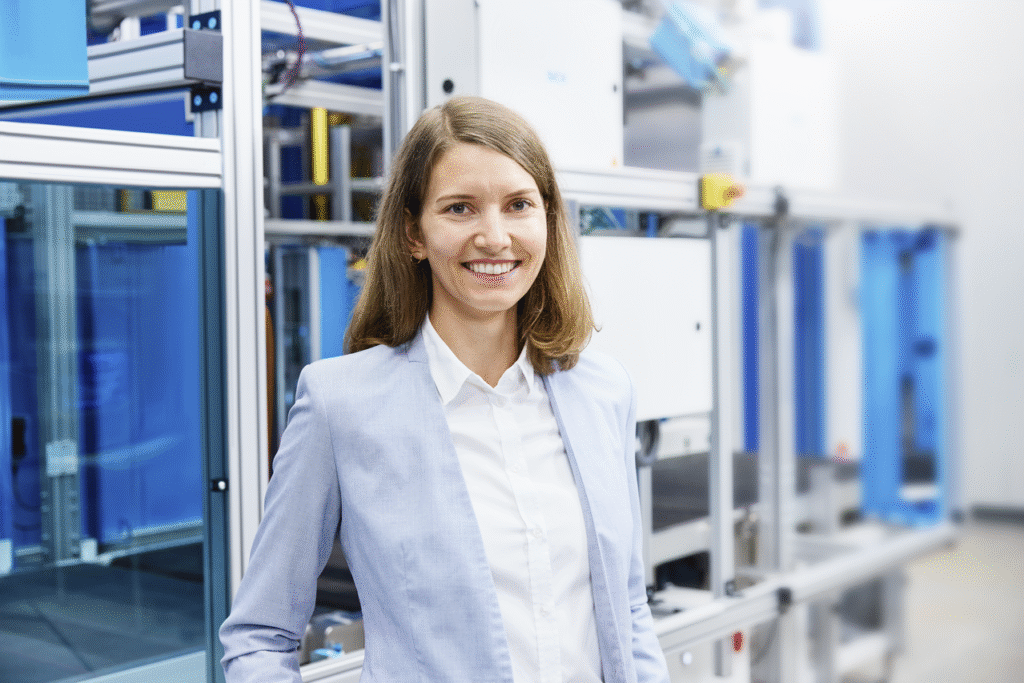
Petra Schumacher is a Project Manager in R&D at SICK AG, where she leads development projects for next-generation optical and vision sensors. With a background spanning optics, spectral imaging, software engineering, and machine vision, she is also deeply committed to empowering young women to explore engineering and STEM fields.
Episode Chapters
Click onto the chapters to access the relevant section of the transcript below.
1. Intro & Women in Vision Series – Josh sets the scene, introduces Petra, and frames the episode’s focus.
2. Early Machine Vision Projects – Petra discusses the vineyard disease-detection project and how spectroscopy reveals plant health.
3. From Research to Real-World Applications – How she transitioned from complex lab setups to practical machine vision systems.
4. Petra’s Background & Path Into Engineering – Her studies in mechanical engineering and optics, early internships, and discovering image processing.
5. Representation & Challenges for Women in Engineering – Why women remain underrepresented: expectations, stereotypes, and the leaky pipeline.
6. Supporting Girls & Inspiring Future Engineers – Petra’s work teaching programming, mentoring students, and being a visible role model.
7. Petra’s Role at SICK & Future of Vision Tech – Her current R&D work, plus the growing impact of AI and interconnected sensors.
8. Looking Ahead & Closing Thoughts – What’s next for Petra, final reflections, and Josh’s closing remarks.
Episode Transcript
[00:00:00.240] – Petra Schumacher
Technology and science, they are a lot about experimenting, about trying out, about also failing and getting up again, trying again, but eventually succeeding. I think that encouraging girls to take more risks could be one major step here, not only to open up the field of technology.
[00:00:18.720] – Josh Eastburn (host)
Welcome to the MV Pro podcast. In the United States where I live, we’re kicking off the winter holiday season this week. As this episode debuts, I have no doubt many of you listeners are saying hellos, thank yous, and goodbyes as you arrive, enjoy, and depart all kinds of gatherings. Similarly, the podcast takes a slight departure today as we highlight Women in Vision, part of an ongoing series of articles in MVPro Magazine. This isn’t the first time we featured a female guest on the show, but in our first year, let’s be honest, it’s been a lot of dudes. Today’s guest is helping to change that for the field of machine vision. Petra Schumacher is not only an experienced engineer, researcher, and project manager within computer imaging, She also calls empowering girls and women in technology a personal passion. Petra graduated in optical engineering in 2021 from the Karlsruhe Institute of Technology in Germany. She followed her education with research into hyper and multispectral imaging before taking a position with notable sensor manufacturer Sick AG, where she currently works as project manager in the R&D group. She describes herself as driven by connecting the dots of different disciplines. Solving new challenges in and inspiring others to join the field of engineering.
[00:01:31.870] – Josh Eastburn (host)
Today’s special coverage of women in vision is sponsored by AIRON. If you’re tired of overpaying for machine vision components, AIRON delivers high-end laser triangulation sensors, precision lenses, lighting solutions, industrial computers, and more at a smarter price. As systems integrators with 15 years of experience, AIRON only sells what it trusts in its own projects. Stop paying more. Shop at AIRON at aoi-airon.com. Shipping globally today.
[00:02:03.070] – Josh Eastburn (host)
Okay, let’s begin. I read through your LinkedIn profile a little bit in addition to some of the background that you sent me, and I was really impressed by what you had done early on in your education and your early career. You’ve had a series of internships and research positions with companies that I recognize as being influential in the space of optics and vision even before starting your current position with SICK. And I wonder what’s been your favorite application that you’ve worked on so far in vision, in computer imaging? Because you’ve touched a number of different applications.
[00:02:41.500] – Petra Schumacher
So, I think it’s really difficult to just pick one favorite application, but I think one project that really influenced me a lot was one that I did very early on in my career when I just started after graduation in a research institution. And the task was to detect diseases in plants at an early stage to come up with early warning systems in viticulture. And what impressed me most about that topic was to see how many disciplines are involved in machine vision. It’s not only the people that are bringing up the camera hardware or the image processing software, but there’s so much application knowledge that’s going into these machine vision applications. And in this case, mostly from agriculture, from viticulture, also some biologists who were especially looking into the diseases. So that’s what stuck with me, that machine vision is such a broad field that has so many entry points and that it’s so diverse and it’s not only the technology behind it, but also the problems that can be solved with it.
[00:03:48.000] – Josh Eastburn (host)
Yeah, and more and more all the time. A lot of what we talk about on the podcast is new industries that are trying out vision or finding new applications for vision. But I do, I am really curious because this is not an application that we have touched on before in the show. So, I’m wondering what are some of the specific technologies that were relevant?
[00:04:07.720] – Petra Schumacher
Yeah. So, I’m basically coming from the more specialized corners moving towards a standard application. So, I studied optics and I caught an interest in spectroscopy very early. And so, the next logical step was spectral imaging, which is quite a niche in the field of machine vision at the moment. But I think it’s quite widespread in science. So, yeah. This was my entry point coming from very complex hyperspectral, multispectral imaging, moving towards more simple applications. And I think that’s still a very interesting field that is also moving into other fields out of science. But I also appreciate that there are so many different levels of applications. There are these really sophisticated niche applications that need a very, very specialized setup. And on the other hand, we have very simple applications that can be solved by any smartphone. So, there’s this whole band within between and yeah, going into all fields of life, basically.
[00:05:08.720] – Josh Eastburn (host)
And so, I’m sorry to keep banging on this, but this is just really interesting to me. I’m geeking out a little bit here. How does spectroscopy help to detect disease in plants? Connect those dots for me.
[00:05:22.800] – Petra Schumacher
So, when plants are, when they have some sort of disease, their metabolic system changes a little bit. So what we did, we were looking at the leaves and you can see the changes in the, in the reflectance spectra of the leaves. So, depending on the composition of the pigments in the leaves, you can start identifying diseases at an early point. And as you can imagine, these vineyards, they are quite huge. And if you are just a person going through the vineyards, you could not even keep up with all the changes that are coming up every day with every season. And so automated systems are really a big, yeah, big step forward in agriculture to cover large fields of land.
[00:06:10.700] – Josh Eastburn (host)
Absolutely. In that application, were you looking, was this, let’s say a contained lab research type of setup? And if so, what would this look like potentially in a deployed production environment? Are we bringing plant samples into a lab on a regular basis? Is there vision in the field? What would that look like in the real world?
[00:06:30.460] – Petra Schumacher
In that case, that was a research project. So, we started with bringing the lab to the field and build a system that contained this spectral camera so we could take the camera to the field. And of course, it’s not so convenient to have this large setup. And so, the goal was to come up with a smaller system that was specialized on the type of disease that we were looking into. Yeah, it was starting in a very complex way, moving to a more practical setup. But of course, that is research, but this is not the field that I’m working in today. So today it’s mostly about factory automation and logistics. So that’s a very, very different field. But still, it’s very interesting to see what are the possibilities that Machine Vision is offering.
[00:07:23.380] – Josh Eastburn (host)
Yeah, you clearly appreciate Machine Vision. And I mean, I can see the enthusiasm right in your face. But early on, right? Young Petra, what led to your interest in computer imaging? How did that first start? And then how did you go about turning that into a career? Because I’m sure there are a lot of people who still have that question.
[00:07:45.010] – Petra Schumacher
Yeah. so, I did my masters in Optics. Actually, my intention was to do cool stuff with lasers. It turns out I’m doing cool stuff with cameras today. But so, during these studies, I had one major turning point where we had a course where we’re supposed to develop business case based on an optics related idea. So it was quite broad. And me and my team, we came up with the idea of coming up with a device that could detect mold in apartments. Sounds a bit weird, but actually it’s a huge problem. And yeah, this showed me that machine vision image processing is not really rocket science and you can start with very simple processing and already have some significant success here to really see the features that you’re looking into. And so, I started to become more and more interested in what I could do with image processing. And what I think is also one big advantage of this technology is that it’s so relatable. So we all see something with our eyes and all the processing that’s coming behind. It’s so complex what our brain is doing and structuring that in an artificial way with some kind of image processing system. This transfer also was very interesting to me. So, I wanted to work on, yeah, on these technologies that would mimic what our brain is doing each and every day.
[00:09:11.770] – Josh Eastburn (host)
So, you already had an interest in engineering and optics, it sounds like, by the time you got into your Master’s work, is that right?
[00:09:19.460] – Petra Schumacher
Yeah. So, I, I did my bachelor’s degree in Mechanical Engineering with a, yeah, with the aim of really, yeah, jumping into this technical field. I’m lucky enough that both of my parents were engineers, so I had this engineering gene early on. And I also grew up with technology surrounding myself. So, it came somehow natural. But of course, I know that this is not a standard situation and it doesn’t apply to a lot of people.
[00:09:50.270] – Josh Eastburn (host)
Sure. I actually had the same experience growing up. My father was a control systems engineer and my early career was in industrial automation also. So, I understand from my own experience the influence that kind of early exposure can have on your educational choices, certainly. And, you know, obviously we’re doing this interview, especially as part of our Women in Vision series that we’ve been doing through MV Pro Magazine. And we’ve had a number of interviews there with influential female innovators in the field. And I’m wondering from your personal experience so far, how often have you met other women who have that early interest in engineering or have been able to turn it into a career?
[00:10:32.420] – Petra Schumacher
I wish it was more often, definitely, that’s for sure. And I cannot really quantify it, but it was really just a few of them in these interface disciplines, for example, let’s say agriculture or medical technology. It’s more, it’s not yet 50-50, but at least it’s, yeah, in a I would say healthy range in industrial automation. Unfortunately, it’s not that common to meet other women, especially not in the technical roles. Of course, we have more female product managers, for example, but in these pure technical roles, it’s very few of them. And yeah, I hope this portion is increasing in the future and that it will be more at some point.
[00:11:15.980] – Josh Eastburn (host)
Yeah, I think we can all agree on that. We would like to see more diversity. More of a balance, more representation there. But what do you think are some of the things that are getting in the way of that happening? What are some of the obstacles that you think prevent us from seeing that kind of balance?
[00:11:36.380] – Petra Schumacher
Yeah, I think it really starts at quite an early point that we have different expectations in society regarding boys and girls or men and women, and that young boys, they are expected to be adventurous while young girls are expected to be caring and well behaved. And I think that’s one really dangerous trait that we associate these kind of stereotypes with one or the other gender. And I think technology and science, they are a lot about experimenting about trying out about also failing and getting up again, trying again, maybe failing again, but eventually succeeding. So, I think that encouraging girls to take more risks could be one major step here, not only to open up the field of technology, but also a lot of other roles that are quite male dominated at the moment. Another aspect I think is really important is role models. And I think we have way too few role models, female role models and engineering roles in the media or in the public. And of course, also in the personal environments typically. And, that’s something that I think could also help a lot to see that it’s perfectly normal for a woman to become an engineer.
[00:12:51.390] – Petra Schumacher
And that it’s nothing special or there are these TV shows and movies that have these geeky, nerdy girls that are typically not associated with very positive traits. And I think this has to change that seeing women doing technology is the most normal thing in the world. And I think there’s quite a long way to get there. And then of course, Out of these few women that choose engineering roles, there is quite a big portion that is leaving this field again. Maybe you have heard the term of the leaky pipeline. And yeah, that’s quite a common thing to see that women don’t feel appreciated in this male dominated surrounding or don’t feel hear or their perspective seen. So, I think that’s something that we also need to work on to make women feel welcome. And then we could find some, yeah, self accelerating process to more women being role models, attracting more women into engineering roles, and eventually having a more diverse and more innovative environment.
[00:14:00.660] – Josh Eastburn (host)
A quick pause to thank our sponsor. If you’re tired of overpaying for machine vision components, AIRON delivers high end laser triangulation sensors, precision lenses, lighting solutions, industrial computers, and more. At a smarter price. As systems integrators with 15 years of experience, Airon only sells what it trusts in its own projects. Stop paying more. Shop at Airon. @aio-airon.com Shipping globally today.
[00:14:30.910] – Josh Eastburn (host)
I know this is something you’ve said you’re passionate about, right? Empowering the next generation of women engineers. What specifically are you doing to make that happen.
[00:14:44.410] – Petra Schumacher
What I like to do a lot is to support young girls and women to take the first step into technology. I have been doing quite a range of programming courses for school children. And what makes me really happy is to see somebody realizing that it’s really not that difficult and that you can easily take the first step and then gradually building upon this first step to build an interest and build your own applications and so I’m doing these courses for young girls, but also for university students. And I would have loved something like this to show that there is really not such a big barrier to get started. And everybody starts from zero. So, it’s not like you have to be an expert when you get started, but you can eventually get there like in any other topic as well. Then also what I’m trying to do as well is being a role model for young girls and for women networking in my company to, for example, support students that are joining to listen to them, to find out what are their challenges and to support each other.
[00:15:56.620] – Josh Eastburn (host)
That’s awesome. I was thinking about some of those early experiences again that I had. I had a high school teacher My high school happened to have a computer science program when I think those were still early. And not, but not only did we have the program, the person who was in charge of the program made everybody in that class feel competent and respected, even though we were all a bunch of nerds, right? The class was, I mean, I think there might have been one, one girl in that class, maybe two. So by and large, male, but the, the spirit, right, of, of camaraderie and respect for intellectual pursuits of serious problem solving, right, the developing engineering discipline, he just made us feel really good about pursuing this, this interest. Um, and it sounds like you’re trying to do something similar for, for women who are taking an interest, for girls who are taking an interest in technical fields. Is that right?
[00:17:01.300] – Petra Schumacher
Yeah, and I really like to spark this idea of, maybe a technical role could be something for me. And, I know that a lot of girls have not been in contact with technical roles until going to secondary school at some point. And yeah, just showing what is possible, what is there. And that I also did these courses in university with a group of other women. And it was such a great experience to also show that we are just perfectly normal women. Doing these things, doing computer science, doing optics, doing other technical things that it’s not something that somebody must be afraid of, or you must be only into these fields, but you can also have a lot of other interests. That’s perfectly fine. And yeah, you just need to get started at some point and then you can build on that.
[00:17:48.120] – Josh Eastburn (host)
If you, let’s say, let’s say there’s a parent, right? A mother or father who sees the value of technology and is maybe curious about encouraging that interest in a child, right? Maybe they see a child that has an interest in technical things, but they’re not technical themselves. What are some good places to get started? What are some ways of exposing young people who might have an interest? What are some early technologies that might be helpful for nurturing that interest?
[00:18:18.730] – Petra Schumacher
Yeah, well, there might be local initiatives probably in some places more. If you’re in a city, of course, it’s easier to find something like that. Some groups, some societies that are really fostering interest of girls in science or maybe even universities that are giving courses or trainings for younger people. If you don’t live in a city and if it’s just quite difficult to find these local initiatives, I think there are quite a lot of online resources available that really everybody can get started with. So, what I’ve been doing with some of these girls, there are these little game pads that you can just program and then program your own computer games on it. And I think this is something that everybody can do. And there are all these big open source projects, also smaller projects to get started. And I think it doesn’t really matter too much where to get started. Just getting started in itself is the most important thing. And then trying out different things and something might be more fun than something else. And yeah, I think it’s just about trying out, trying to explore all the opportunities that are out there. And it doesn’t necessarily have to be technology in the end, but I think exposing to different, different topics, to different fields of science, that’s, the most influential thing to do, I guess.
[00:19:50.030] – Josh Eastburn (host)
Yeah. Maybe there’s just a certain kind of thinking or a kind of problem solving fundamental skill, right, that we’re trying to expose young girls to. Because I think of other women that I know who work in law or who work in medicine, which are also incredibly difficult fields, right? They’re demanding. But probably also, we see a similar gender disparity there. I’d like to talk a little bit about the work that you’re doing at SICK now, right? You’re still working in research, is that right?
[00:20:17.730] – Petra Schumacher
Well, I work as a project manager now in research and development, so I’m not doing the development myself, but I’m overseeing the research and development projects for future machine vision applications. I have started in a developer position, but I have transitioned to more coordinative role now. And I think that’s also one very nice thing about the field of machine vision that it covers so many different disciplines. And now being in an interface discipline also gives me a lot of different perspectives that I’ve not had when I was only developing, but yeah, now I see also all the interconnected other topics.
[00:21:03.380] – Josh Eastburn (host)
So, seeing from that perspective of being able to see across all the different disciplines that are necessary for bringing these applications together or developing sensing technologies, as I imagine, SICK is probably doing. What are some of the technologies that you’re excited about that you see in kind of in development now and that be growing over the next five to ten years?
[00:21:27.060] – Petra Schumacher
Well, I think it doesn’t sound very creative, but I think that the influence of AI systems will just become more and more important. And yeah, we also have AI software implemented in some of our sensors already, and we see the big benefit that this is bringing that suddenly applications are solvable that have not been solvable before because using just classical image processing algorithms and stacking them together would be so difficult. And using these AI systems just brings a lot of ease of use and yeah, a lot of simplicity. And I think that this is going to be become more and more important. And also the connection and sorry, no, let me try to say that again.
[00:22:19.340] – Josh Eastburn (host)
Okay.
[00:22:19.370] – Petra Schumacher
Yeah. What I think is also coming more and more is the interconnection of different sensors, different cameras to oversee what is going on overall in some kind of facility and not just looking at each of the cameras individually, but seeing them as a whole that also displays the dependencies between each other. and I think that’s bringing in the analysis software to have all this information condensed in one way, this will also be something that is going to become more and more important.
[00:22:53.240] – Josh Eastburn (host)
Interesting. So, is that something that SICK is working on right now?
[00:22:56.920] – Petra Schumacher
Yeah, definitely. We are a company that does not only provide the sensors, but that also provides the connectivity to have a whole system of sensors. And in that way, also facilitating applications that require several pieces of information from different types of sensors, bringing that together and helping customers with informed decisions is one of the, I would say, overall goals that we’re trying to solve.
[00:23:26.570] – Josh Eastburn (host)
That’s really interesting. I can imagine what you’re talking about. I don’t have the experience, I think, to think of a concrete application. But I think we’re all familiar with the idea of, for example, in conveyance, right? We have scanning tunnels. Where we’re looking for different types of anomalies at the same time that we’re trying to also scan a barcode and make decisions about quality and sorting and all that kind of stuff. So, I don’t know if that’s what you’re talking about, or if it’s something even maybe more complex than that, but I think that is a really interesting field to be working in. I get the impression from your comments and from looking at your CV that you, so you said you started off in mechanical engineering, so you would have had some hardware background, but it sounds like your experience in optics has largely been driven by software, is that right? The image processing side of Machine Vision.
[00:24:15.210] – Petra Schumacher
Yeah, partially. I have started from hardware, then somehow took the side entrance to software via image processing. Now moving back a little bit towards hardware. So, it’s somewhere in between, sometimes more on the software side, sometimes more on the hardware side. Yeah, I think for me, having this non-linear background is really a big benefit that I can communicate between both worlds. And that also helps me in my role as a project manager today to understand each of these disciplines without having too much of a focus on only one of them.
[00:24:57.220] – Josh Eastburn (host)
Yeah, I agree. That’s always been helpful. Yeah. And I think vision in particular is multidisciplinary. What’s next for you? You’ve been with SICK for a few years, is that right?
[00:25:10.220] – Petra Schumacher
Well, yeah, I’ve been with SICK for three years now. And what’s going to be next for me in the nearer future is I have some very interesting projects going on at the moment that I’m very excited to see launching on the market in the next couple of years. And then I think we live in such a fast-paced world that it’s very hard to predict what will be the next big thing in, let’s say, three or five years. But I’m sure it will be exciting and I’m sure there will be a way to really shape this next big thing in machine vision and to drive some very interesting applications here.
[00:25:43.620] – Josh Eastburn (host)
Thank you so much for taking the time to talk today and thank you for your comments. This will be great and I hope that it does encourage some young people to take an interest or more likely some old people who are in technology right now and trying to deciding how to encourage their young people in their life to move forward with this interest. That’s really our goal with this series. So, thank you for helping us do that.
[00:26:06.920] – Petra Schumacher
Yeah, thank you so much for, for having me here today. And yeah, I’m really excited to, to see the results. And I hope, yeah, that it’s going to be something that some listeners will be interested in. And let’s see.
[00:26:20.840] – Josh Eastburn (host)
Yeah. We have lots of people to thank for today’s episode. First of all, thank you to our North American editor at large, Rachel Levy Sarfin, for her great work on the Women in Vision series over at MV Pro Magazine. Thank you also to AIRON for sponsoring this episode. And thank you, of course, to Petra for responding to our call for interviewees in this series and to SICK for their help in giving this episode the attention it deserves. If you’d like to hear more of this kind of coverage, please reach out to us at editor@mvpromedia.com We’d love your input. If you aren’t in the holiday spirit yet, let this be your call to action. Our next episode which I’m very excited for is our 2025 wrap up with our very own CEO and editor in chief, Tom Tiner. Can you believe it’s that time already? For MV Pro Media, I’m Josh Eastburn. Be well.