
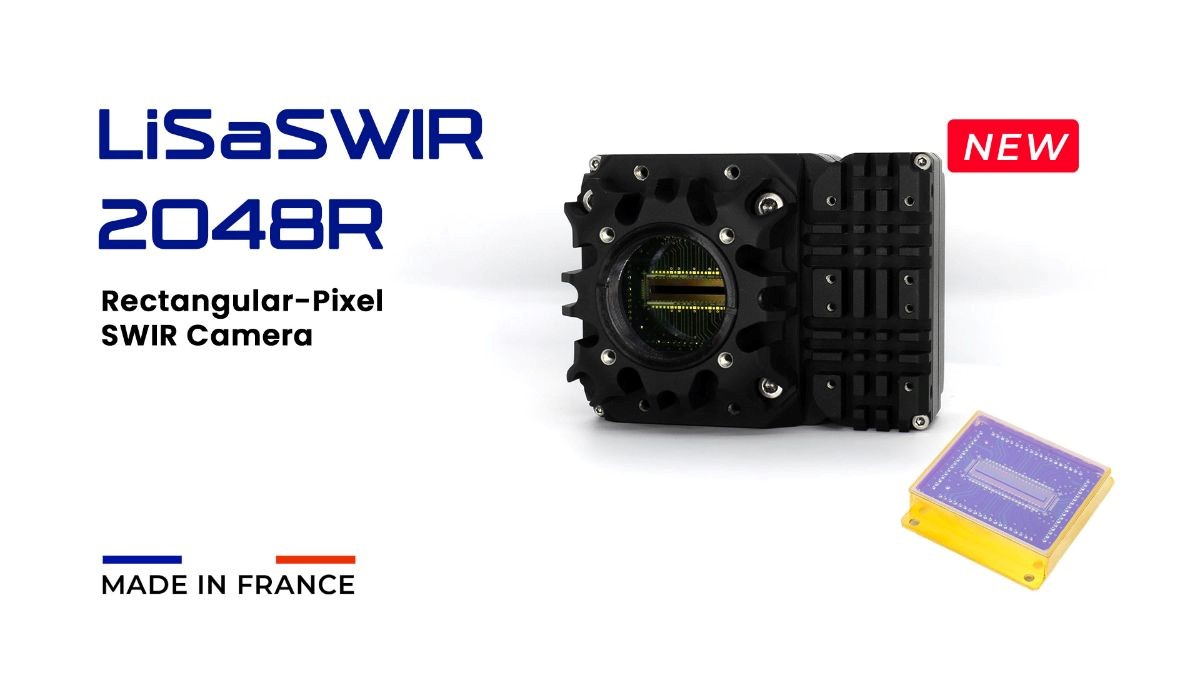
New Imaging Technologies, has announced the availability of the LiSaSWIR 2048R M-STE2, a new rectangular-pixel SWIR camera designed specifically for spectroscopic and line-scan optical architectures. The release builds on the company’s established LiSaSWIR 2048 v2 platform while introducing a sensor geometry tailored to highly specialized optical configurations.
At the core of the LiSaSWIR 2048R is its distinctive 8 × 200 µm rectangular pixel format. Unlike conventional square pixels, this elongated geometry is optimized for applications where spatial sampling and spectral resolution must be carefully aligned with the optical path. In spectroscopic systems, pixel shape can directly influence light collection efficiency, signal uniformity, and overall system throughput. For line-scan implementations in particular, rectangular pixels can better match slit geometries and dispersive elements, reducing wasted light and simplifying optical design.
The camera is positioned for two primary application domains: spectroscopy and Optical Coherence Tomography (OCT). Both demand high sensitivity in the shortwave infrared (SWIR) range while maintaining tight control over spatial and spectral characteristics. In OCT systems, where signal fidelity and depth resolution are critical, sensor optimization plays a significant role in achieving stable and repeatable performance. Similarly, spectroscopic platforms benefit from pixel architectures that align with the dispersion axis and maximize photon efficiency.
Importantly, the LiSaSWIR 2048R leverages the proven electronics and integration framework of the LiSaSWIR 2048 v2. For OEMs and research groups already familiar with the platform, this continuity should ease adoption and reduce development risk. Rather than introducing an entirely new architecture, NIT has opted to refine and adapt an established design, a pragmatic move that suggests the product is responding to defined market needs rather than speculative feature expansion.
What stands out is the increasing emphasis on application-specific sensor geometry within the SWIR sector. Imaging discussions often center on resolution, frame rate, or sensitivity metrics. Yet in advanced analytical and medical imaging systems, pixel architecture can be just as consequential. The move toward rectangular formats signals a growing recognition that optical efficiency and system alignment are integral to performance optimization.
This release also reflects a broader industry shift: sensor manufacturers are collaborating more closely with integrators and system designers to solve targeted challenges. In fields such as spectroscopy and OCT, where incremental gains in signal quality or stability can translate into measurable analytical improvements, tailored sensor formats are not simply niche variations, they are enabling technologies.
For system designers working in SWIR-based analytical instrumentation, the LiSaSWIR 2048R merits careful evaluation. Its combination of established platform reliability and geometry optimized for spectroscopic workflows positions it as a specialized yet practical addition to the evolving SWIR landscape.