
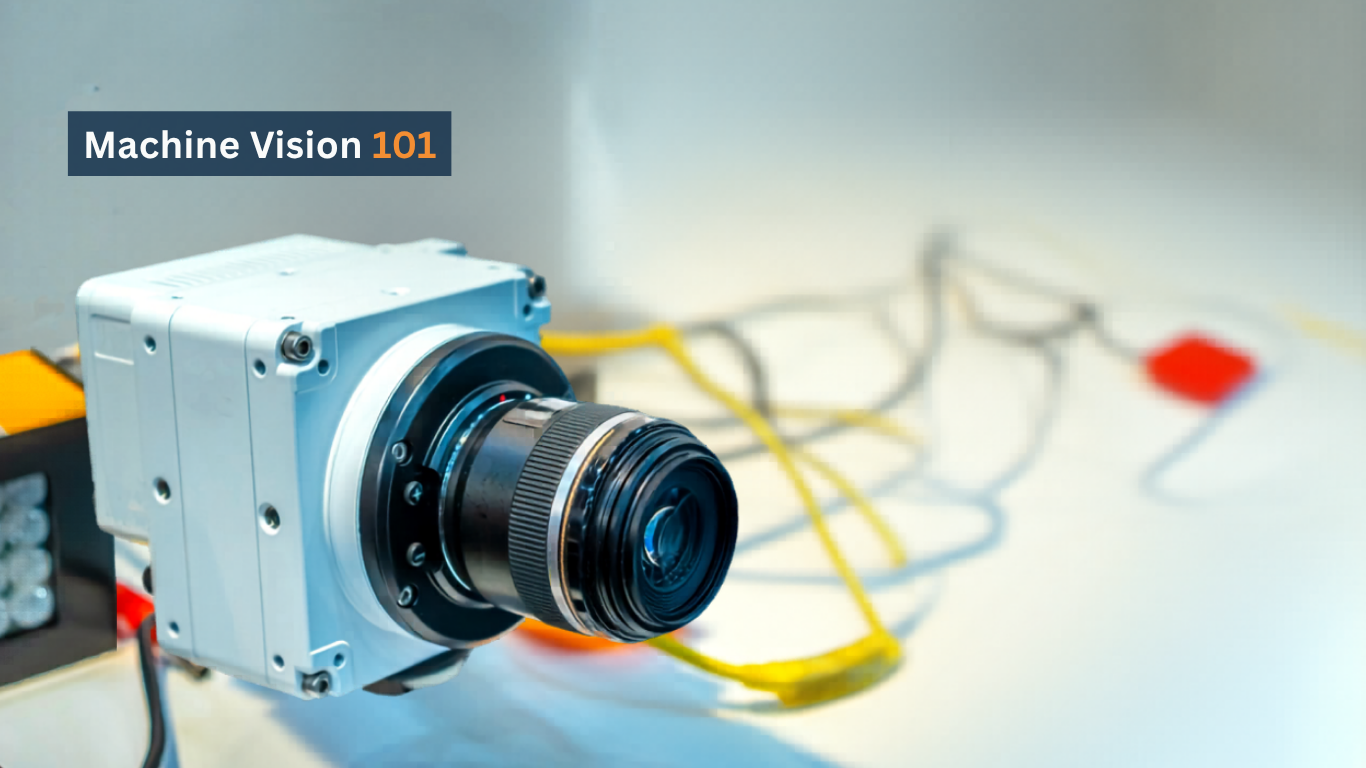
This article is part of our Machine Vision 101 series, where we break down the fundamentals behind reliable vision systems.
By Mark Williamson, Editor-at-Large, MVPro Media
In the previous instalment of our Machine Vision 101 series, we explored why lighting is often the most consequential decision in any machine vision project. But even the most carefully designed illumination strategy is wasted if the optics cannot resolve the detail you need to see.
The lens is the bridge between the physical world and the digital image, and selecting the wrong one will limit system performance in ways that no amount of software can recover. Yet optics are still frequently treated as an afterthought. Engineers invest significant effort in camera selection and lighting design, only to bolt on a lens late in the process based largely on compatibility or cost.
The consequences are predictable: soft images, uneven illumination across the field of view, distortion that undermines measurement accuracy, or systems that drift out of focus over time in production environments. Getting the optics right is not difficult, but it does require understanding a few fundamental principles.
Lens Types and Mounts
The majority of machine vision applications use fixed focal length lenses mounted via C-mount, the long-established standard for compact industrial cameras. For larger format sensors, F-mount lenses have traditionally been the preferred option. However, as sensor sizes continue to grow, the industry is gradually shifting toward medium-format optics. Canon’s EF-mount in particular is becoming increasingly common because it offers a larger image circle and wider lens availability for modern high-resolution systems.
Different applications also place very different demands on the optics themselves.
Telecentric lenses occupy a specialist but increasingly important niche. Conventional lenses exhibit perspective distortion, meaning objects appear smaller as they move further from the camera. Telecentric designs eliminate this effect by maintaining constant magnification throughout the depth of field. This makes them essential for precision dimensional measurement and metrology applications where accuracy matters more than aesthetics.
The trade-off is size and cost. Telecentric lenses are physically larger and significantly more expensive than standard optics, but in many inspection systems they are the only practical solution.
Macro lenses complete the core group, designed for close-range imaging at high magnification where extremely fine detail must be resolved. These are common in semiconductor inspection, electronics manufacturing, and medical device applications where the field of view may be measured in millimetres rather than centimetres.
Manufacturers such as Kowa, Tamron, FUJINON, and ZEISS offer industrial lens ranges specifically designed for machine vision, with optical performance far beyond typical consumer photography lenses.
MTF, Resolution, and the Reality of Modern Sensors
If there is one specification that separates a genuinely capable machine vision lens from a mediocre one, it is the Modulation Transfer Function, or MTF.
MTF describes the lens’s ability to transfer contrast and fine detail from the physical scene onto the sensor at different spatial frequencies. A lens with strong MTF reproduces detail with clarity and contrast. A lens with poor MTF produces softer images where detail is blurred or lost entirely.
This matters more today than at any point in the industry’s history because sensor technology has advanced so quickly.
A decade ago, industrial cameras commonly used pixels around five or six micrometres in size. Today, pixel sizes of two micrometres or smaller are increasingly common. Smaller pixels can theoretically resolve finer detail, but only if the lens itself can deliver enough optical resolution to the sensor plane.
A high-resolution sensor paired with a low-performance lens is effectively wasting pixels.
Lens manufacturers have responded by developing optics specifically optimised for small-pixel sensors. Kowa’s JCM series and Tamron’s MA series are good examples. But engineers still need to verify that lens MTF performance is sufficient for the spatial frequencies demanded by the chosen sensor rather than assuming megapixel compatibility alone guarantees performance.
Image Circle and Vignetting
Another critical but frequently overlooked factor is the relationship between the lens image circle and the sensor size.
Every lens projects a circular image onto the sensor plane. The sensor must sit entirely within this image circle. If it extends beyond it, the corners of the image will become dark or completely unilluminated.
Even when the sensor technically fits within the image circle, many lenses still exhibit vignetting: a gradual reduction in brightness from the centre of the image toward the edges.
With older, smaller sensors this was often negligible. Modern larger-format sensors expose these limitations far more clearly.
A lens designed for a two-thirds-inch sensor, for example, may vignette heavily when paired with a one-inch sensor. The resulting uneven illumination can complicate thresholding, metrology, and AI-based inspection consistency across the field of view.
As sensor sizes continue increasing, ensuring proper image circle coverage and reviewing manufacturer vignetting data becomes increasingly important.
Coatings, Filters, and Ruggedisation
Optical performance is not determined solely by sharpness and resolution.
Every glass-to-air surface inside a lens reflects a small amount of incident light. In multi-element lenses, these reflections accumulate, reducing image contrast and introducing internal flare. Anti-reflection coatings help mitigate these effects. High-quality multi-layer coatings reduce reflections significantly, preserving both contrast and transmission efficiency.
Filters also remain among the most underutilised tools in machine vision system design.
Bandpass filters matched to the illumination wavelength improve contrast and suppress ambient light. Polarising filters reduce glare and specular reflections. Infrared cut filters prevent unwanted long-wavelength light from affecting image consistency.
These are relatively inexpensive additions, yet they often make the difference between a system that works reliably in a controlled lab environment and one that performs consistently on a production line.
Production environments also create mechanical challenges that are easy to underestimate during system design. Vibration, temperature cycling, and mechanical shock can gradually shift focus or loosen lens assemblies over time.
Recognising this, several manufacturers now offer ruggedised industrial optics with vibration-resistant locking mechanisms, reinforced mounts, and sealed housings designed specifically for harsh factory conditions.
If the camera is mounted near moving machinery or robotics, specifying ruggedised optics from the outset is far cheaper than diagnosing intermittent focus drift months after deployment.
Fixed, Motorised, and Adaptive Optics
For most machine vision applications, fixed focal length lenses with locked aperture and focus remain the best choice. Once commissioned, there is little to drift, recalibrate, or fail over time. In industrial environments, simplicity and stability remain major advantages.
However, a growing number of applications now require dynamic optical control.
Robotic inspection systems with varying working distances, multi-product manufacturing lines, and focus stacking applications all benefit from controllable optics.
Companies such as Birger Engineering and Theia Technologies offer motorised lens systems capable of electronically controlling focus, zoom, and iris directly through vision software.
Liquid lenses, pioneered by Optotune, take a different approach. By electrically changing the curvature of a fluid-filled optical element, they achieve focus adjustments in milliseconds without moving mechanical parts. This makes them particularly attractive for high-speed or vibration-sensitive applications.
The industry is also moving gradually toward greater standardisation. The EMVA’s Open Optics Camera Interface initiative aims to integrate lens control directly into camera systems themselves, reducing the need for separate controllers and simplifying deployment.
Adoption remains relatively early, but the direction is clear: controllable optics are steadily moving from specialist capability toward mainstream machine vision infrastructure.
Final Thoughts
Optics may not receive the same attention as AI software or the latest sensor technology, but they remain one of the defining factors in whether a machine vision system succeeds or fails.
As sensors continue pushing toward smaller pixels and larger formats, the demands placed on optical quality are only increasing.
The fundamentals remain straightforward:
- Ensure the lens can resolve the detail your sensor requires
- Verify MTF performance at the relevant spatial frequencies
- Match the image circle properly to the sensor format
- Understand vignetting behaviour
- Specify coatings and filters deliberately
- Design for environmental stability from the beginning
These decisions are rarely the most glamorous part of a machine vision project, but they are often the decisions that determine whether the system works reliably outside the lab.
As with lighting, one of the best independent resources for practical optics guidance remains Vision Doctor, particularly for its field-of-view calculators and lens selection tools.
The fundamentals of machine vision are rarely complicated. But they are unforgiving when ignored.