
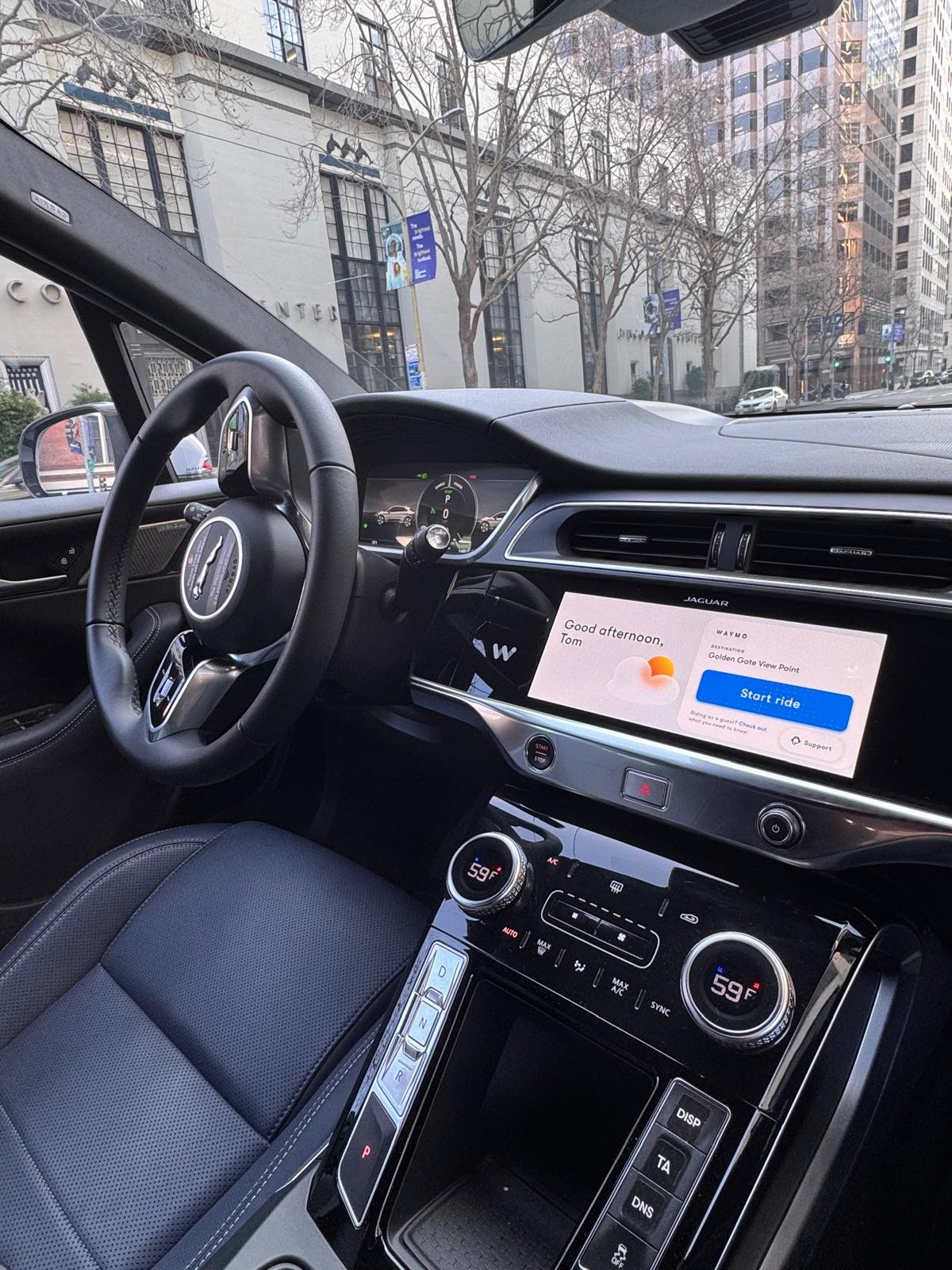
There is a moment in every significant technology shift when abstraction gives way to experience, when theory stops being discussed and starts being felt. For me, that moment arrived not in a lab, a conference hall, or a product demo, but sitting in the seat of a Waymo autonomous taxi. What struck me almost immediately was not novelty or spectacle, but calm. The car moved with quiet confidence, free from the tension, impatience, or overcorrection that so often characterises human driving. It felt less like witnessing a technological experiment and more like stepping into a system that already understood its role.
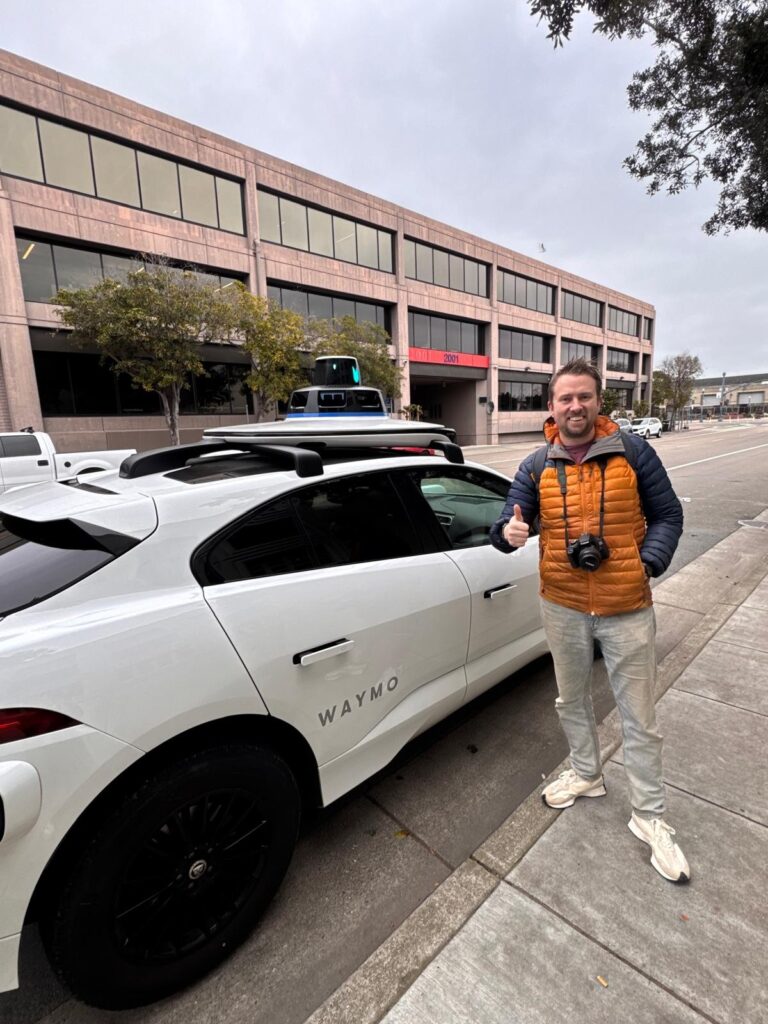
As the journey progressed, I became increasingly aware of how little there was to notice. No sudden braking, no exaggerated caution, no awkward pauses. The experience was smooth and deliberate, the kind of ride that quickly fades into the background, which is perhaps the highest compliment one can pay to any transportation system. Yet the moment that truly crystallised my confidence came unexpectedly, at a blind corner where the real world presented one of those everyday problems that often expose the limits of automation.
As we rounded the corner, a car appeared parked on the wrong side of the road, completely blocking our path. It was the kind of scenario that causes human drivers to hesitate, inch forward, or make uncertain gestures to other road users. The Waymo responded differently. It slowed smoothly and came to a controlled stop, without drama or abruptness. There was a brief pause, just long enough to understand that the system was assessing the situation rather than reacting impulsively. Then, with measured assurance, it identified a safe route around the obstacle and proceeded. The manoeuvre was calm, precise, and unhurried. Watching the vehicle reason its way through an ambiguous situation with such composure was genuinely impressive.
From a machine vision perspective, moments like this are where autonomy either earns trust or loses it. This was not a scripted edge case or a rehearsed demonstration. It was an un-signposted, imperfect real-world scenario, handled with a level of confidence that suggested maturity rather than experimentation. What became clear is that Waymo’s system does not simply detect obstacles and stop. It perceives, evaluates, predicts, and then acts, all within a framework designed to prioritise safety and consistency above speed or assertiveness.
At the core of this capability is Waymo’s multi-layered perception system, known collectively as the Waymo Driver. Rather than relying on a single sensing modality, the vehicle integrates high-resolution cameras, multiple lidar units, and radar sensors to create a continuous, 360-degree understanding of its environment. Lidar provides precise three-dimensional spatial awareness, radar contributes velocity and motion data even in challenging conditions, and cameras add semantic understanding, recognising traffic lights, road markings, vehicles, cyclists, and pedestrians. Individually, each sensor has strengths and limitations. Together, they form a resilient, redundant perception stack designed to cope with uncertainty.
What differentiates Waymo’s approach is not just how much data it collects, but how it interprets that data in real time. Machine learning models process these sensor streams to detect and classify objects, estimate their trajectories, and predict likely future behaviour. Crucially, the system is not merely reacting to what it sees in the present moment. It is constantly forecasting what might happen next. That predictive capability is what allows the vehicle to pause at a blind corner, reason about the blocked road ahead, and confidently select an alternative path without appearing hesitant or abrupt.
This emphasis on prediction and redundancy speaks to a broader philosophy within Waymo’s engineering approach. The system is designed with the assumption that the real world is messy, unpredictable, and often imperfectly signposted. Vehicles park where they should not. Pedestrians behave unpredictably. Road layouts vary, signage degrades, and lighting conditions change. Rather than attempting to eliminate uncertainty, the Waymo Driver is built to manage it. That design philosophy was evident throughout the ride, not just in how the car handled challenges, but in how consistently it behaved when nothing unusual was happening at all.
Waymo’s confidence is underpinned by scale and experience. The company has logged tens of millions of miles in autonomous driving, both on public roads and in simulation, using that data to refine its perception and planning models. Its robotaxi service, Waymo One, now operates across multiple U.S. cities with a growing fleet and hundreds of thousands of paid rides each week. This is no longer a pilot programme or a research exercise. It is a commercial service operating in complex urban environments, exposed daily to the unpredictability of real traffic.
From a passenger’s perspective, however, the complexity remains largely invisible. What matters is how the ride feels. There is something subtly transformative about sitting in a vehicle that never rushes, never loses patience, and never becomes distracted. Trust in autonomy is not built through novelty or spectacle, but through predictability and composure. Over the course of the journey, that trust quietly accumulated. By the end, the absence of a driver no longer felt remarkable. It felt normal.
Reflecting on the experience, it is clear that machine vision is no longer simply about enabling machines to see. It is about enabling them to understand context, manage uncertainty, and make decisions that align with human expectations of safety and responsibility. The blind corner and the blocked road were not dramatic moments, but they were revealing ones. They showed how far perception, sensor fusion, and decision-making have progressed, and how close autonomous systems are to behaving not just competently, but confidently.
As I stepped out of the Waymo at the end of the ride, the strongest impression was not that I had glimpsed the future, but that the future had arrived quietly and without fanfare. Autonomous driving did not announce itself with bold claims or aggressive manoeuvres. It simply encountered a problem, assessed it calmly, and carried on. For an industry that has long promised transformation, that understated competence may be the most convincing signal yet that autonomy, powered by mature machine vision, is ready for everyday life.