

By Rachel Levy Sarfin, Editor at Large
This article provides a high-level overview of where the machine vision market is heading, intended for readers who want context rather than deep technical detail.
As 2025 draws to a close, it’s a good time to think about what the next year holds in store. It looks like good news for the machine vision market—analysts are optimistic about its continued growth.
Learn more about 2025’s trends and what will shape 2026 and the future.
2025: A Retrospective
Understanding the past year requires looking a bit further back.
Analyst firm Interact Analysis published a report in the middle of May this year forecasting 1.5% growth for the machine vision market. Revenue has been down since 2022. In that year, revenue fell from $6 billion to $5.8 billion, and has continued to fall in subsequent years.
Tariffs will also impact growth, even if many companies have not reported an impact. Interact Analysis’ Jonathan Sparkes noted companies might simply absorb the cost of tariffs into their prices.
However, Sparkes commented that organizations are investing in more complex machine vision solutions, which could drive growth. He cited the example of 3D cameras replacing the 2D variety. 3D cameras can perform multiple tasks or automate workflows, whereas 2D cameras don’t have the same capabilities.
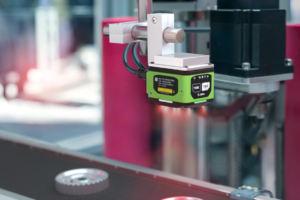
Automation is also driving the machine vision market, as machine vision solutions play a significant role. For instance, a machine vision solution can scan products for defects faster and more effectively than human staff.
Predictions for 2026 and Beyond
While analysts predicted limited growth for 2025, the years ahead are a different story.
The Business Research Company predicts growth at a CAGR of 9.5% to reach $21.81 billion by 2029. Analysts from ResearchAndMarkets.com anticipate the market will expand at a CAGR of 7.90% from 2025 to 2034, striving towards an estimated $23.27 billion by 2034. Business Research Insights focused its predictions on the 3D machine vision market, predicting a CAGR of 6.1% to reach $2.6 billion by 2034.
What’s Driving This Growth?
Experts expect automation to continue contributing to the growth of the machine vision market. Automation contributes to operational efficiencies.
A human performing quality control can only catch so many errors. When a company doesn’t catch a product error, it could lead to a costly recall at best. The minimum worst-case scenario is customer injury.
Machine vision solutions can catch errors or defects much faster and at a higher rate of accuracy. They can also scale up; a human can’t effectively catch errors for multiple products at a time. However, a machine vision solution with a camera can scan many items and catch errors or defects.
Which Industries Will Drive Growth?
Various experts have put forth ideas about which industries will drive growth in the machine vision market.
ResearchandMarkets.com sees a strong push from the automotive industry, because of its inspection and verification requirements. Machine vision solutions can perform these tasks more efficiently and effectively than human staff.
Staff at Control Engineering predict logistics applications such as warehouse automation, battery manufacturing, and agriculture will contribute to the expansion of these solutions. In the publication’s mid-year forecast, writers noted agriculture is an untapped market with significant potential.
While these industries don’t sound like they have similarities, all of them require precision and high levels of quality. In automotive and battery manufacturing, a defective component could lead to customer injury or fatalities. For agricultural products, quality control could mean the difference between allowing potentially spoiled produce onto shelves, which could lead to similar results. The consequences for warehouses might not be so dire, although picking the wrong product could lead to costly returns, which hurts customer trust.
Other Factors Affecting Machine Vision Market Growth
In addition to automation and industrial demand, there are other factors enabling machine vision growth.
Technology
The technology behind machine vision has also improved significantly. These improvements go beyond the cameras used to capture images; cloud APIs, edge computing, and AI models are factors.
Application programming interfaces (APIs) connect data to applications. Think of them as outlets: the data is the electricity, and the application you’re plugging in will consume that data. A cloud API connects backend cloud components so applications can access data stored in the cloud. With so much data residing in the cloud, it’s crucial machine vision applications can access it quickly and easily.
Edge computing means that data is processed locally, as opposed to being sent to a server. It saves time, which is essential for activities such as quality control. Advances in hardware have made edge computing more accessible. Vision AI accelerators, also known as neural processing units (NPUs) can run lightweight AI models directly on cameras and sensors, so data doesn’t need to travel back to a server.
We’re also seeing improvements in the AI models that machine vision solutions use for training. Some industry experts see a shift towards foundation models and multimodal AI. Foundation models are AI models capable of a range of tasks, such as text synthesis, image manipulation, and audio generation). Multimodal AI systems can process and integrate various data types (such as text and visuals). The capabilities of foundation models and multimodal AI can make machine vision more powerful and easier to use, even without large amounts of training data.
Challenges to Market Growth
Although analysts predict high levels of growth for the machine vision market, it won’t be without challenges.
Investing in machine vision solutions comes at a high upfront cost. The companies that need them most, potentially in developing economies such as southeast Asia, might not be able to afford them. Moreover, companies investing in these solutions will need skilled professionals to operate and maintain them. At the moment, a skills gap exists, so such professionals are in short supply.
Companies will also need to consider their cybersecurity posture. If a company doesn’t have strong defenses in place, hackers, criminals, or terrorists could launch adversarial attacks on machine vision solutions. Something as small as a signal introduced into a system could cause a solution to change its decision-making patterns. For example, it could misidentify a defect, costing the company thousands of dollars.
Achieving Machine Vision Success in 2026 and Beyond
What will machine vision success look like next year and in the future?
It might mean making a smaller investment, or waiting until the price comes down to afford the equipment and technology infrastructure.
It will definitely mean investing in training as well as cybersecurity to ensure you have the right people and the right security measures in place. These steps will help you maximize your investment and protect it well into the future.
Want to go more in-depth? Read Machine Vision & The 2026 Crystal Ball: What’s Next for the Industry?