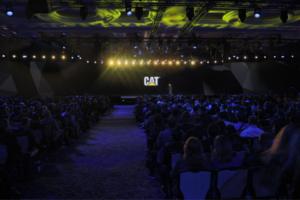

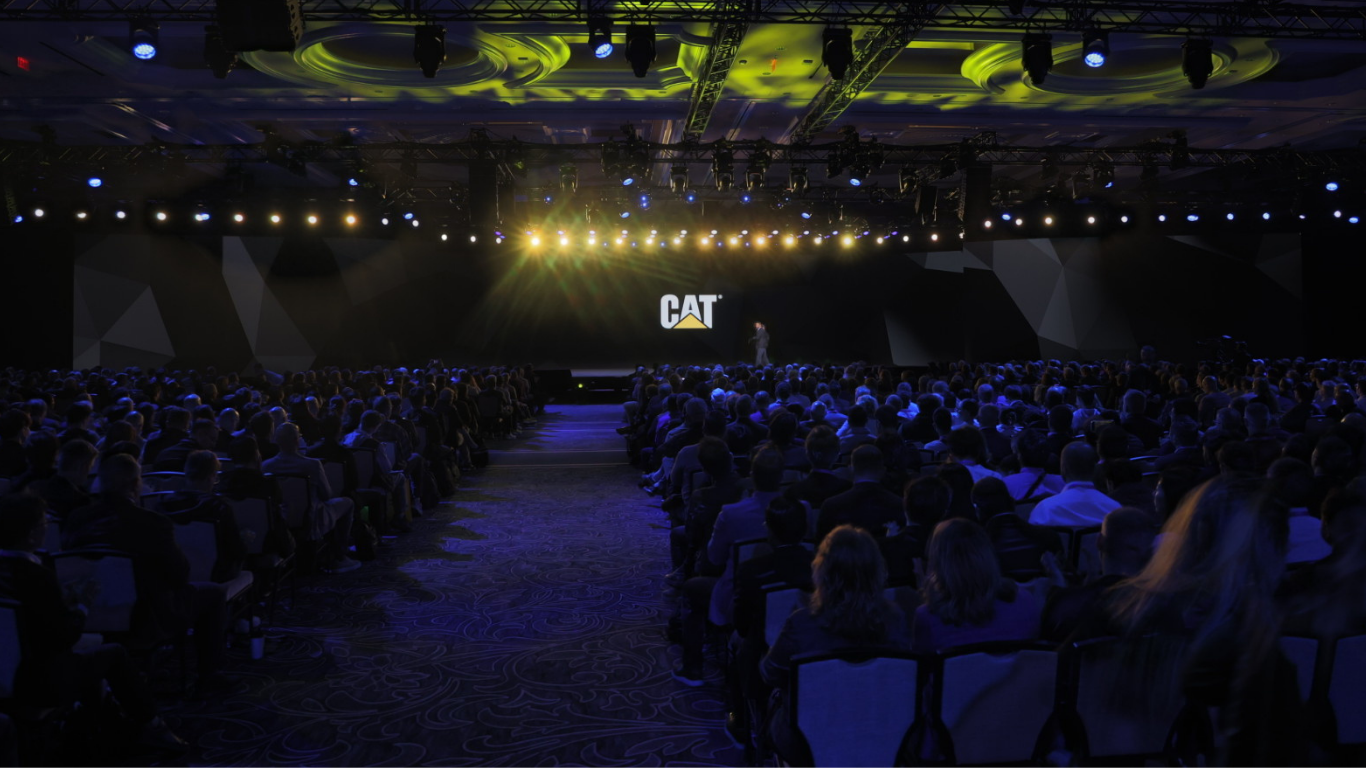
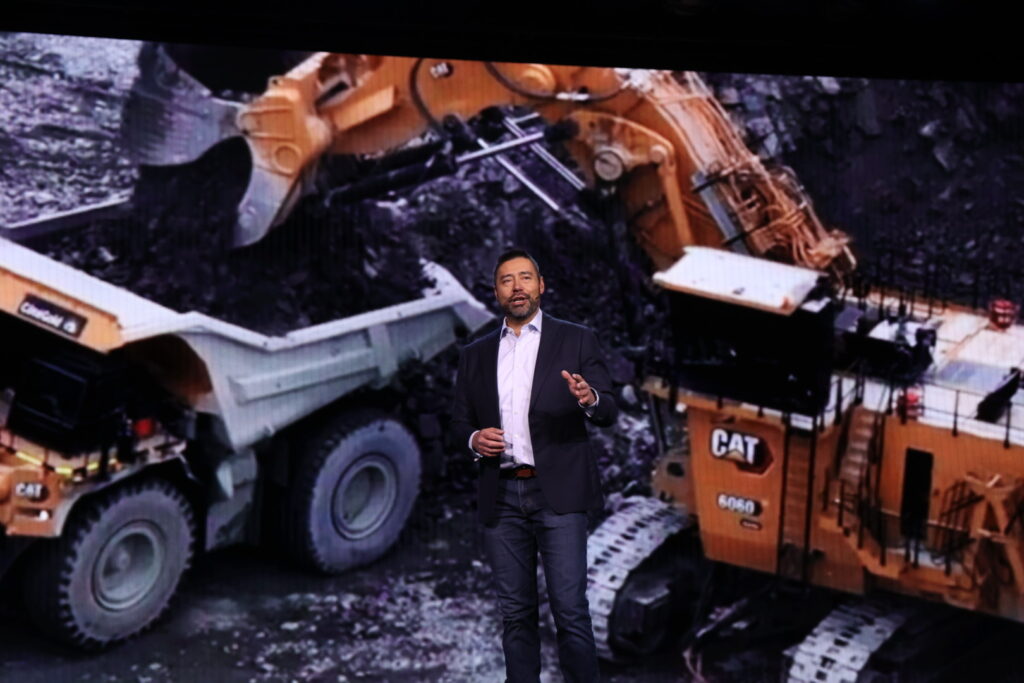
CES® 2026. Photo Credit Consumer Technology Association (CTA)®.
At CES 2026, Caterpillar did not present machine vision as a breakthrough technology. It presented it as something far more consequential.
Across keynotes, demonstrations, and conference sessions, Caterpillar framed perception as a foundational capability inside autonomous and semi-autonomous industrial systems. Vision was not introduced as a feature to be admired, but as an operational necessity that underpins safety, decision-making, and productivity in some of the most demanding environments imaginable.
That positioning matters. It tells us a great deal about where industrial machine vision is headed next.
This maturity is underpinned by decades of autonomy deployment, multi-sensor perception, and edge AI and digital-twin workflows developed in partnership with NVIDIA. The technology stack matters, but at this stage, it is no longer the headline.
Vision as Infrastructure, Not Innovation Theatre
At CES 2026, Caterpillar’s messaging was notably restrained. There were no bold claims about algorithmic breakthroughs or performance benchmarks. Instead, the emphasis was on reliable operation in real worksites: environments defined by dust, vibration, human presence, and constant change.
This restraint is telling. Caterpillar is not experimenting with perception; it is operationalising it at scale. Decades of autonomy deployment, multi-sensor perception, and real-time decision-making underpin systems that are already moving billions of tonnes of material in the field.
In that context, vision is no longer presented as innovation to be admired. It is treated as infrastructure — assumed, embedded, and judged by outcomes rather than features.
From Seeing to Acting
What stood out most was not that Caterpillar uses vision, but what it expects vision systems to do.
These are not inspection tools producing advisory outputs. They are systems that contribute directly to action. Machines adjust behaviour, avoid hazards, and intervene in real time. Vision feeds decisions that carry safety, financial, and operational consequences.
This moves machine vision firmly out of the comfort zone of laboratory benchmarks and controlled environments. It places it squarely in the realm of accountability.
In Caterpillar’s world, a perception error is not a missed defect on a production line. It is a potential safety incident or a costly operational failure. That raises the bar dramatically for robustness, explainability, and long-term reliability.
The Human Role Does Not Disappear
One of the more telling aspects of Caterpillar’s CES presence was how clearly humans remained in the picture.
Autonomy was framed as assistance and augmentation rather than replacement. Operators, supervisors, and maintenance teams are still responsible for outcomes, even as machines take on more independent action. Vision systems support that responsibility, but they do not remove it.
This aligns with a broader pattern emerging across industrial vision deployments. As systems act more autonomously, the human role shifts from direct control to validation, intervention, and accountability. That shift is rarely reflected in system design, yet Caterpillar’s messaging implicitly acknowledged it.
Machine vision here is not just about perception. It is about enabling safe human-machine collaboration at scale.
Why This Matters for the Wider Vision Industry
Caterpillar’s CES 2026 presence offers a glimpse of where machine vision delivers the most value, and where expectations are highest.
First, it reinforces that industrial vision success is no longer defined by peak performance in isolation. It is defined by how systems behave over time, in harsh conditions, under uncertainty.
Second, it shows that vision is increasingly judged at the system level. Cameras, models, and sensors matter, but only insofar as they integrate cleanly into broader autonomy stacks and operational workflows.
Finally, it highlights that responsibility is becoming a design constraint. When vision informs action, someone remains accountable. Systems that do not make uncertainty visible or decisions understandable will struggle to scale, regardless of technical capability.
A Quiet Signal From CES
Caterpillar did not use CES 2026 to announce a vision revolution. It used it to demonstrate maturity.
That, perhaps, is the most important signal for the machine vision industry. The future of vision is not defined by louder claims or more spectacular demos. It is defined by whether systems can be trusted to operate in the real world, alongside people, with real consequences.
At CES 2026, Caterpillar showed what machine vision looks like when it stops asking to be noticed, and starts being relied upon.