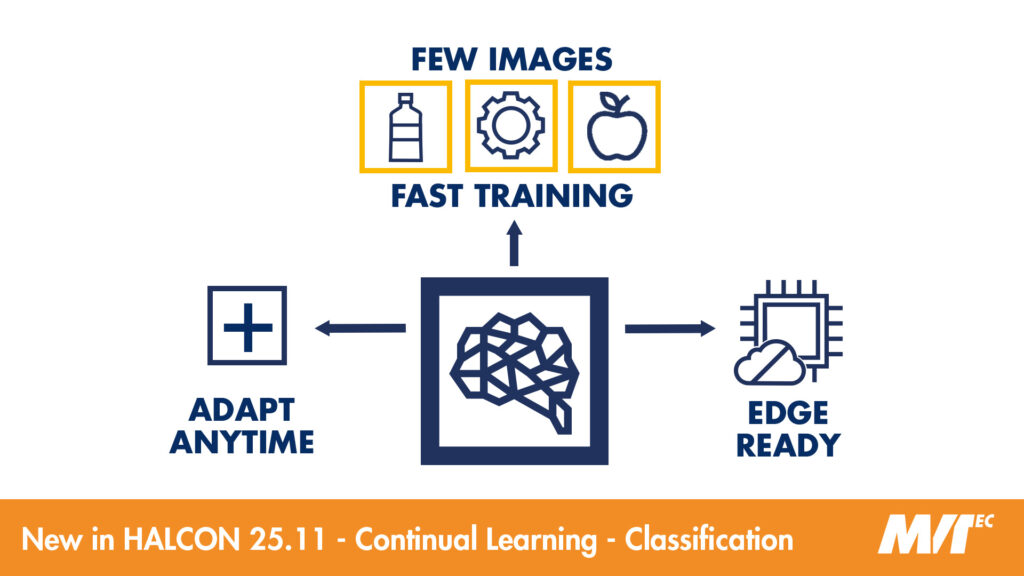

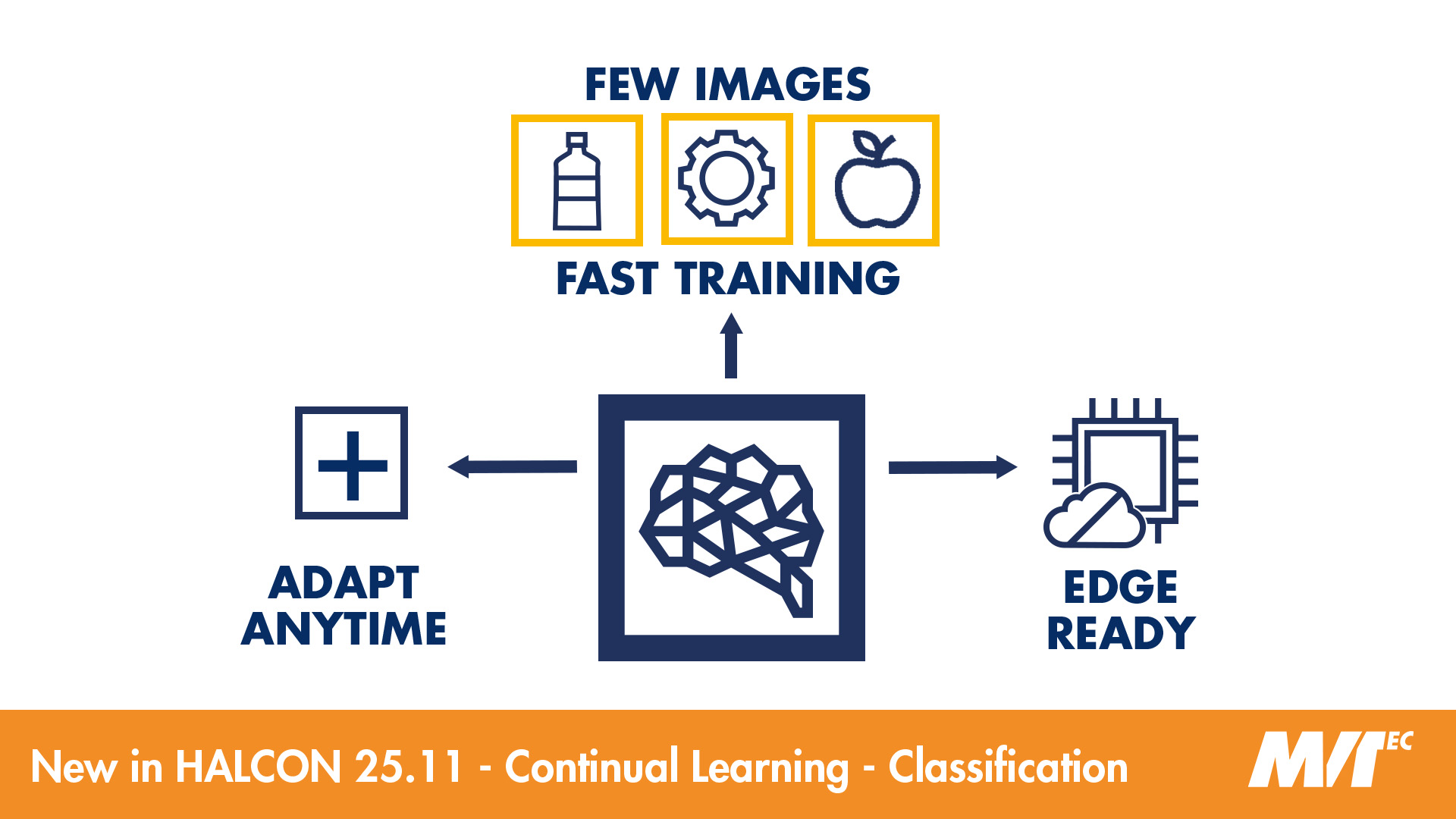
MVTec Software GmbH has developed a new deep learning feature that enables flexible adaptation to changing production environments. Continual Learning enhances the efficiency and speed of retraining deep learning models and requires only a few images, further reducing time and cost. The new feature is part of the latest HALCON version 25.11, which will be released on November 12, 2025.
Production processes are in constant change
“When certain parameters in production change, deep learning–based machine vision applications must be retrained to maintain robust recognition rates. So far, this process has been complex and time-consuming. With Continual Learning in HALCON 25.11, we now offer a feature that significantly reduces the effort required to retrain classification models,”
Jan Gaertner, Product Manager for HALCON at MVTec.
The reasons for changes in production processes vary. Lighting conditions often shift when new illumination is installed, or a production line is expanded or relocated. Supplied parts and preassembled components also tend to show variations over time, for example, in color, material, or surface texture. Such differences are especially common when switching suppliers. These altered conditions can strongly affect quality inspection processes: even minor variations can greatly impact defect detection. This is particularly relevant when new product classes are added or entirely new types of anomalies appear.
Fast, simple, and efficient: retraining with Continual Learning
Continual Learning addresses these challenges by allowing existing classification models to be retrained quickly and easily, enabling flexible adaptation to new requirements in industrial environments. Typically, only five to ten images are needed, minimizing both effort and cost. Another key advantage: Continual Learning is resistant to the so-called “catastrophic forgetting.” This means that during retraining, the neural network continues to correctly recognize the classes and features it originally learned. In addition, Continual Learning requires only a standard CPU instead of an expensive GPU, making it ideal for embedded and edge devices such as smart cameras and sensors. Existing classes can be updated, and new ones added, without the need for complete retraining. Finally, retraining with Continual Learning is so straightforward that it can be performed even by users without in-depth machine vision expertise.